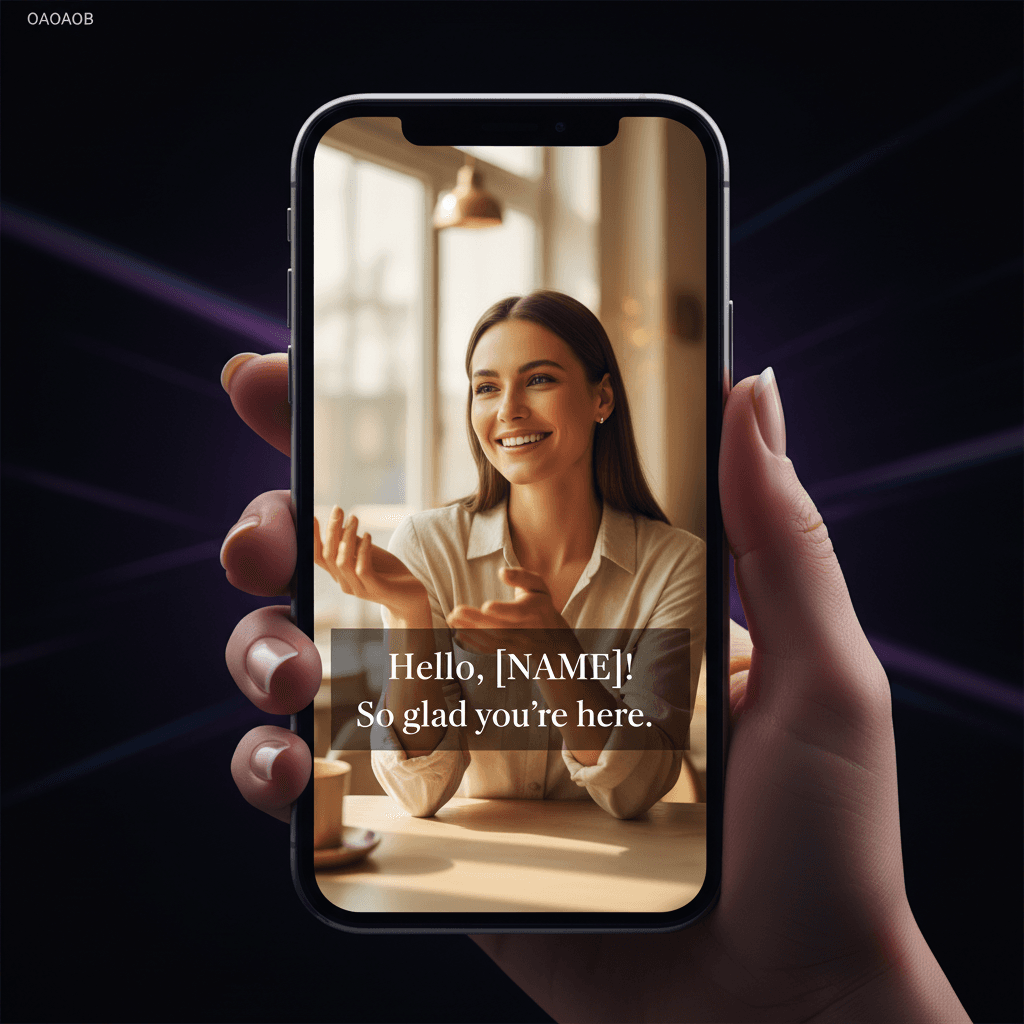
You can't re-record a video for every prospect. That is exactly what AI voice cloning solves: you lend your voice once, and it can then say any visitor's first name, quote their answers, and do it thousands of times without you ever going back to the mic.
This guide is written for merchants, not engineers. We'll cover how the technology works in practice, what the quality is truly worth today, how to stay on the right side of ethics and law, and the use cases that pay off the most.
Voice cloning, in plain terms
A voice clone is a model that has learned the sound signature of your voice: your timbre, your rhythm, your intonation. Once trained, you hand it a text and it reads it in your voice. You type "Hi Marie, here is your personalized plan" and the system says it as if you had just recorded it.
The gap with a generic synthetic voice is huge. A robotic "default" voice sounds like everyone else. Your clone sounds like you — it's your brand the visitor hears, not an anonymous assistant.
How you create your clone in practice
The process is simpler than most people picture. No studio, no expensive gear.
- 01Record a sample: a few minutes of your voice, in a quiet room, with a decent mic (even a good headset often does the job).
- 02Let the model learn: the AI analyzes the sample and builds your voice fingerprint. It takes minutes, not days.
- 03Validate a test: a sample sentence is generated, you listen, and you adjust if needed.
- 04Use it everywhere: your voice becomes a variable. Every generated video can now speak with it.
In Quiz Funnel, this voice plugs straight into the avatar studio: the avatar speaks with your cloned voice, and video generation assembles it all into one unique video per visitor.
The quality, honestly
The technology has come a long way. On short, warm sentences — exactly the kind of message you put at the end of a quiz — a modern clone is hard to tell apart from a real recording. The spoken first name sounds natural, and the emotion comes through.
A few honest limits to know so you aim right:
- Sample quality matters: a clean recording gives a clean clone. A noisy background is audible.
- Rare first names may be pronounced slightly differently; a well-written message limits the awkward cases.
- Very long monologues feel less natural than short, rhythmic sentences — which works out well, since the best closing quiz videos are brief.
“My clients tell me it feels like I recorded the video just for them. They have no idea it's my cloned voice.”
Ethics and consent: the part we don't skip
Cloning a voice is powerful, so it demands rigor. The rule is simple: only clone your own voice, or a voice for which you have explicit written consent.
- Your voice: no issue, it's yours. That's the normal use case.
- A teammate's or ambassador's voice: get written agreement, specifying the use (marketing, duration, right to withdraw).
- Never a third party's voice without agreement: imitating a celebrity or any person without consent is not only unethical, it's legally risky.
On transparency with the visitor, the right instinct is not to deceive. A personalized video is not a lie: it's your real voice, your real message, simply adapted to each person — like a salesperson tailoring their pitch. As long as the content is sincere and you'd say the same thing in person, you're in the right register.
The use cases that pay off
Once your voice is cloned, Quiz Funnel's differentiator kicks in: the closing video says the visitor's first name and quotes their answers. Here's where it changes everything.
- Personalized quiz endings: "Marie, based on your answers, here are your 3 priorities." The visitor feels seen, not bucketed.
- Follow-ups and video emails: a message that says the prospect's name reopens a conversation that had gone cold.
- Client onboarding: greet every new client by name, in your voice, without filming a thousand videos.
- Thank-you pages: turn a plain "thanks for your purchase" into a memorable moment.
This is exactly what sets Quiz Funnel apart from a classic quiz: where others show a frozen result, you deliver a video where your voice addresses each person by their first name.
Clone your voice and launch your personalized videos
A few minutes of recording, and every visitor hears their name in your voice.
Start for freeWritten by
Quiz Funnel
Équipe éditoriale